Black Spider With White Spots on Its Back: What Is It?
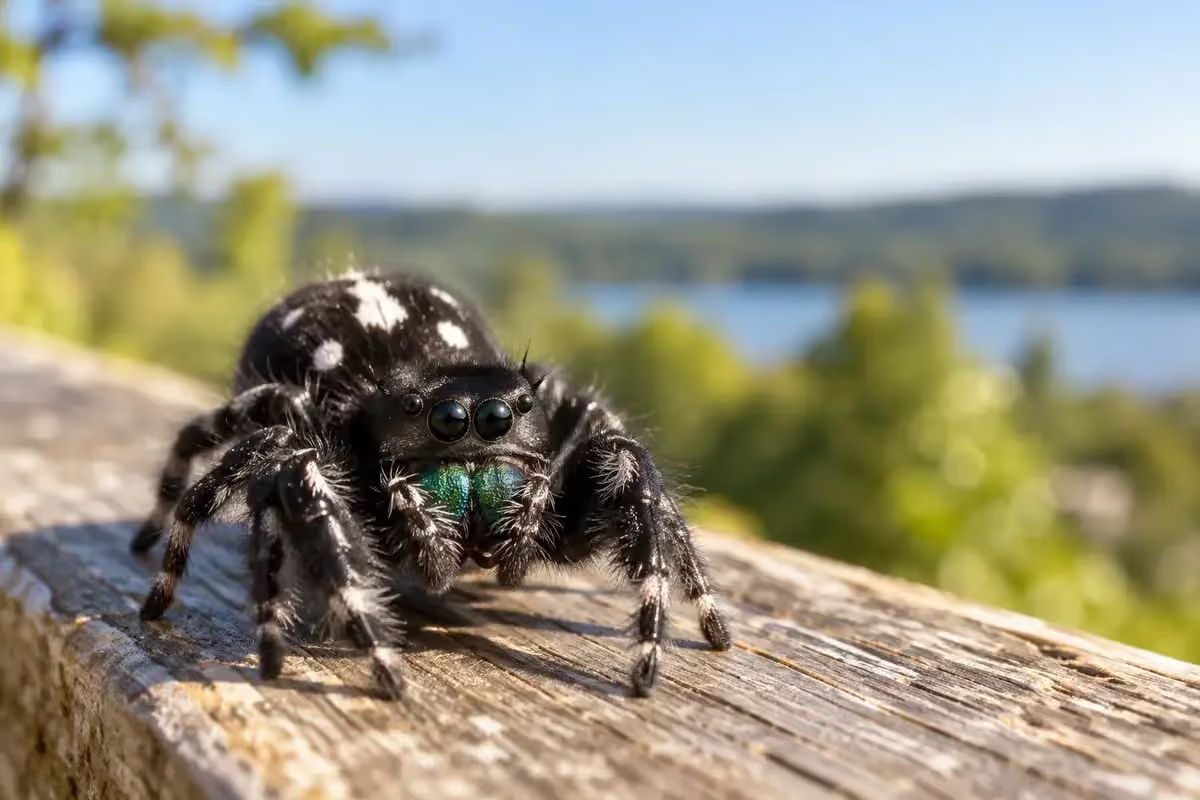
A black spider with a white spot on its back is most likely a bold jumping spider (Phidippus audax), a fuzzy, harmless spider common across North America. It usually has one larger white spot or triangle in the middle of the abdomen and smaller spots around it. A few other spiders also show black and white markings, including zebra jumpers, parson spiders, young widow spiders and false widows. This guide helps you tell them apart and shows which ones, if any, need caution. A photo and the Spider Identifier settle it fast.
Black Spider With White Spot on Back: The Most Likely Answer
The bold jumping spider is the answer in most cases. It is the black and white spotted spider people find most often on decks, fences, windowsills, garden plants and house walls. It is active in daylight, turns to look at you with two large front eyes and moves in quick little hops.
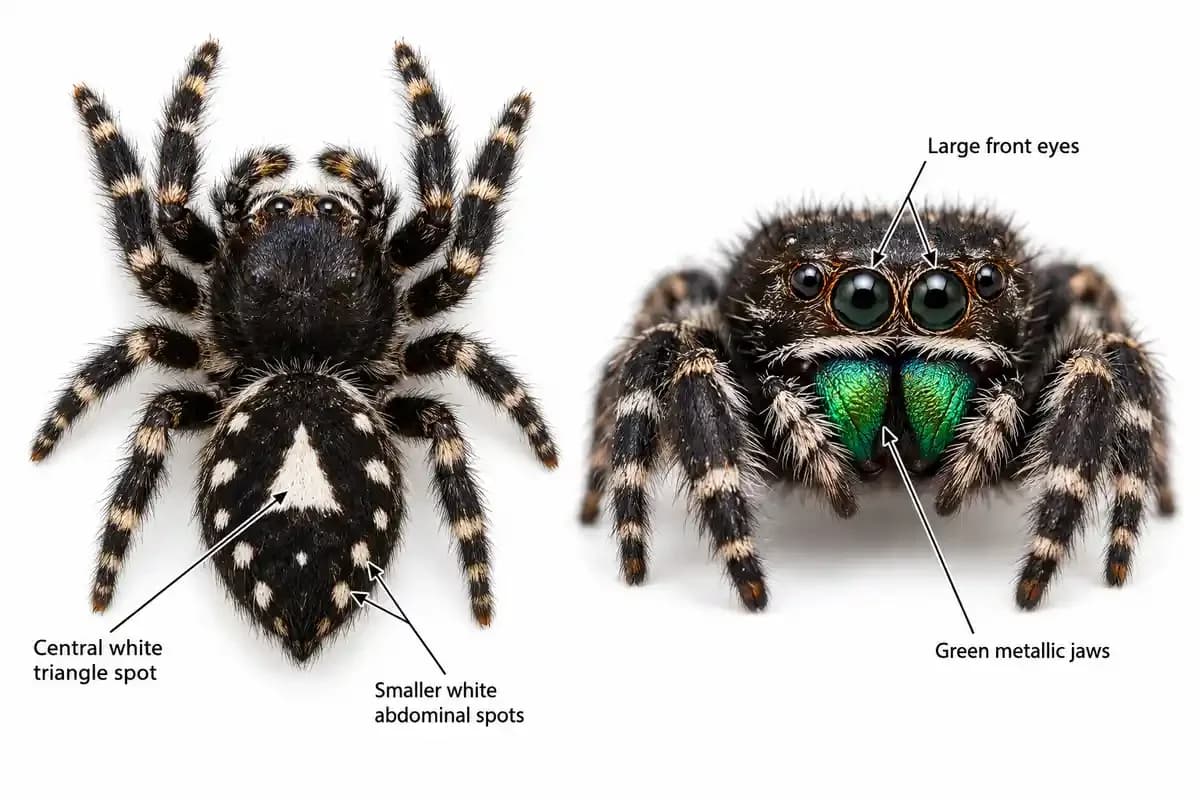
- Markings: a central white or orange spot or triangle on the abdomen, often with two or four smaller spots beside it. Young spiders tend to have orange spots that turn white with age, according to Penn State Extension.
- Body: black and hairy, with short, strong legs, sometimes with white bands on the legs.
- Face: two huge front eyes and shiny, metallic green or blue jaws.
- Size: females 8 to 19 mm (5/16 to 3/4 in), males 6 to 13 mm (1/4 to 1/2 in).
- Range: Canada and the Atlantic coast west to California and south into Mexico.
Males often have white bands behind the eyes and tufts of hair above them, like eyebrows. Bold jumpers hunt by sight in daylight and do not build catching webs. At night and in winter they rest in small silk sacs tucked into cracks, under bark or in the corners of window frames, which is why people sometimes find them indoors in cold months. For more about this family, read our full guide to jumping spiders.
Other Black Spiders With White Spots or Dots
If your spider does not have big front eyes or does not hop, it is probably one of these other black spiders with white spots or markings.
| Spider | White markings | Size (body) | Where you find it | Danger |
|---|---|---|---|---|
| Bold jumper (Phidippus audax) | Central white spot or triangle plus side spots | 6 to 19 mm | Decks, walls, plants, windows | Harmless |
| Regal jumper male (Phidippus regius) | Black with white bands and white spots | Up to about 15 mm | Southeastern United States | Harmless |
| Zebra jumper (Salticus scenicus) | White or gray stripes and bars | 5 to 7 mm | Sunny walls and windows | Harmless |
| Parson spider (Herpyllus ecclesiasticus) | A white pattern down the middle of the back | About 8 to 11 mm | Indoors at night, under stones | Mild bite only |
| Young widow spider (Latrodectus) | White, cream or yellow stripes and spots | A few mm | Messy webs in sheds and woodpiles | Too small to bite through skin |
| Male widow spider | White stripes with red spots | 4 to 6 mm | Near female webs | Not dangerous |
| Noble false widow (Steatoda nobilis) | Cream or white skull shaped pattern | 7 to 14 mm | Walls, sheds, windows in Europe and the US West Coast | Mild bite |
| Black purseweb spider (Sphodros) | Sometimes white marks behind the fangs | About 1 to 2.5 cm | Silk tubes against tree trunks | Rarely bites |
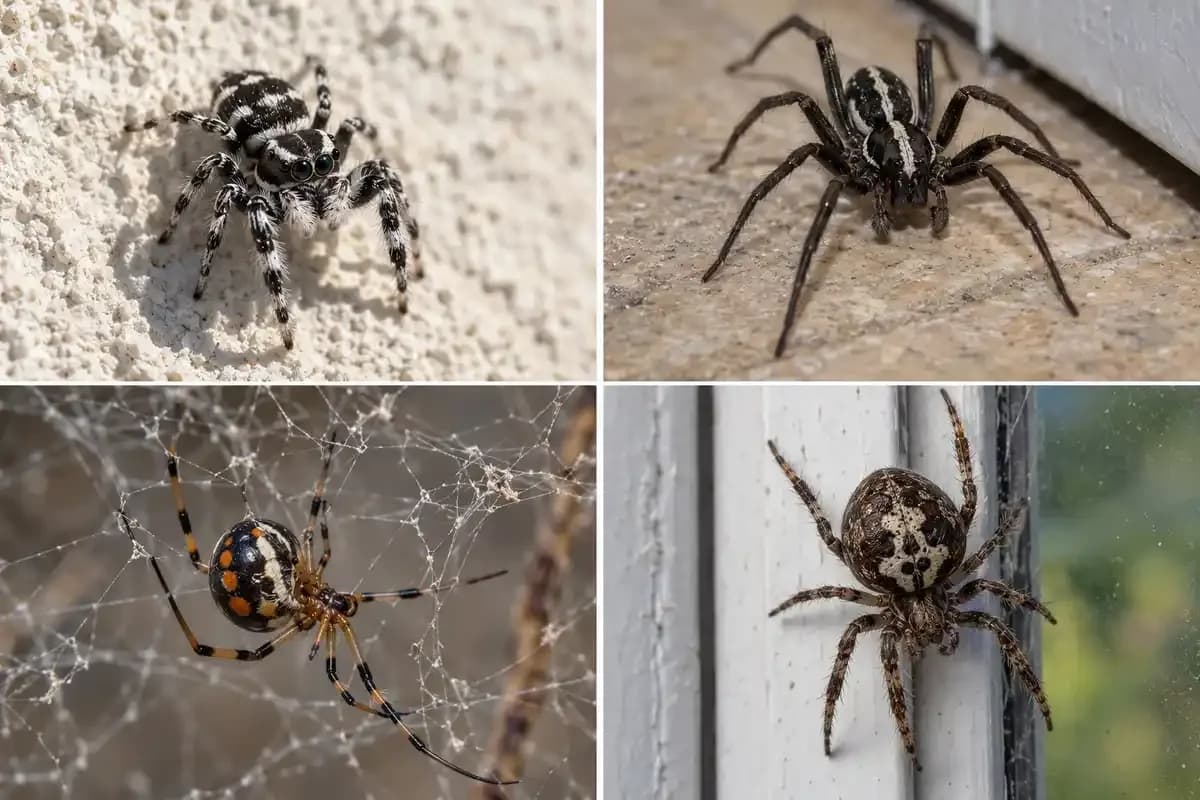
Spiders With a Single White Dot or Patch
A single white dot or patch in the middle of the back is the classic bold jumper sign. If the white patch is shaped like a skull or a pale band on a dark brown body, it is more likely a false widow. A white band across the front of the abdomen with black legs can be a parson spider. Juvenile widows show several thin white stripes rather than one dot.
Black and White Striped or Spotted Jumpers
A small black and white jumping spider with stripes rather than spots is usually a zebra jumper. A larger black jumper with white bands on its legs and white spots on its back may be a regal jumper male in the southeastern United States. All jumpers share the same big front eyes and hopping movement.
Small vs Large Black and White Spotted Spiders
Size is a useful clue, especially when the spider is too small to see its eyes clearly. Small black spiders with white spots, under about 6 mm (1/4 in), are usually zebra jumpers, young bold jumpers or juvenile widow spiders. Larger ones, from about 1 cm (3/8 in) up, are usually adult bold jumpers, regal jumper males, parson spiders or false widows.
- Tiny and hopping: a young jumper or a zebra jumper.
- Tiny and hanging in a messy web: a juvenile widow or a young false widow.
- Large, fuzzy and hopping: an adult bold jumper.
- Large, smooth and running on the floor at night: a parson spider.
- Large, glossy, dark brown with a pale pattern, in a web: a false widow.
Are Black Spiders With White Spots Poisonous?
No. A black spider with a white spot on its back is almost never dangerous. Bold jumpers, zebra jumpers and regal jumpers are shy and harmless to people. Penn State Extension notes that a bold jumper bite, which happens only if the spider is handled roughly, causes minor pain, itching and redness for one to two days.
- Parson spiders: can give a mild, short lived bite if trapped against skin.
- False widows: London's Natural History Museum says their bite usually causes pain similar to a wasp sting.
- Young and male widows: have fangs too small or venom too weak to harm people.
The spider to watch for is the adult female widow, which is shiny black with a red hourglass underneath and no white spots. Read our guide to the black widow spider for her full description.
White Spiders With Black Spots
If the spider is mostly white with black spots, the pattern is reversed, and the most common answer in warm regions is the spiny orbweaver, a small, hard shelled spider with six red spines that sits in a round web. White crab spiders, which wait on flowers, can also show small dark marks. Both are harmless. Some spiders also look white because of a thin coat of pale hairs or dust, so a close photo in good light helps show the real pattern. See our guide to orb weaver spiders for more on the spiny orbweaver.
How to Confirm Which Spider It Is With a Photo
The fastest way to confirm what you found is a clear photo that shows the spider's back and, if possible, its face. Follow these steps for the best result:
- Get close but safe. Use your phone's zoom or a jar so you do not need to touch the spider.
- Photograph the top. Make sure the white spots, stripes or patterns are in focus.
- Photograph the face. Big front eyes confirm a jumping spider right away.
- Note where it was. A web, a wall, a floor or a flower each points to different spiders.
- Check the photo. Upload it to the Spider Identifier to get the species and a safety rating.
Still unsure? Upload your photo to the free ScanaBug Spider Identifier for an instant ID with a safety rating.
Frequently Asked Questions
Sources and References
- Penn State Extension. Bold Jumper Spider.
- University of Kentucky Entomology. Kentucky Urban Spider Chart.
- University of California Statewide IPM Program. Widow Spiders and Their Relatives.
- Natural History Museum, London. How Dangerous Are False Widow Spiders?
- University of Florida IFAS. A Spiny Orb Weaver Spider, Gasteracantha cancriformis.
- Penn State Extension. Southern Black Widow Spider.