Spider IdentifierIdentify Any Spider From a Photo or Picture for Free
What kind of spider is this? Upload a photo to identify a spider with our free AI spider identifying tool and get the species name, caution or avoid danger rating in seconds. Free spider identification for house spiders, wolf spiders, brown recluse, black widow and more.
1,000+
Spider Species
5
Features Analyzed
Seconds
Fast AI results
Upload Your Spider Photo
Get an instant AI identification: species, danger level and a harmless, caution or avoid safety rating.
Drop your spider photo here
or tap to upload from camera or gallery
Supports JPG, PNG, WEBP, HEIC (iPhone) · Max 10MB · Free · No sign-up required
How to Identify a Spider: Upload a Photo or Check These Features Yourself
The quickest way to identify a spider is to send a clear photo to a free AI spider identifier. If a photo is not possible, checking body size, color, eye arrangement and web type narrows most spiders down to one or two likely species. The same steps work for any spider species, from small house spiders to a possible brown recluse.
Get the best photo for identification
To identify a spider from a photo, get close enough that the whole body and leg span are visible in the frame. Use natural light rather than flash, since flash tends to wash out the fine detail in markings that matter most. Take a photo from above and, where it is safely possible, a second photo showing the underside of the abdomen, since this is where black widow markings appear. Never attempt to move or provoke a spider for a better angle.
Upload to the free AI spider identifier
The AI reads the same features a trained arachnologist checks in the field: body shape and size, leg length and thickness, the pattern on the abdomen, eye arrangement where visible and web type if the spider was photographed in its web. Together these checks are usually enough to narrow an unfamiliar spider down to a single family or species. It works like a spider search by picture: instead of typing a description, you upload the image and get a spider ID with the species name.
Read your results
The result card returns the common name, scientific name, family and a danger badge marked Harmless, Caution or Avoid, along with a typical size range and next steps. Use this as a quick spider checker before deciding if any action is needed at all, since the overwhelming majority of spiders people photograph indoors turn out to be completely harmless.
Key Features to Look At When Identifying a Spider
Four features do most of the work in spider identification, and checking them in order narrows the field faster than starting with color alone.
Body structure and size
Every spider has 8 legs and two body sections, the cephalothorax and the abdomen, which is different from insects, which have 6 legs and three body sections. If what you found has 6 legs, use the Insect Identifier instead. Size is best given in inches including leg span, since leg span is usually what a person notices first and body length alone can undersell how large a spider actually looks up close.
Color and markings
Brown, black, and orange are the three colors that come up most often in spider searches. A marking is far more useful when described by its exact shape and its exact location on the body, since a vague description such as spotted or striped rarely narrows anything down on its own.
Eye arrangement
Most spiders have 8 eyes arranged in two rows of four. Brown recluse spiders and their close relatives are an exception, with only 6 eyes arranged in 3 pairs, which makes eye count one of the single most reliable features for confirming that genus specifically when the marking on the back is faint or hard to see.
Web type, if applicable
Not every spider builds a web. Wolf spiders and jumping spiders are active ground and ambush hunters that build no web at all, which is itself a useful clue. The spider web identification chart below maps common web shapes to the spider families most likely to have built them.
| Web Type | Appearance | Likely Family | Example Species |
|---|---|---|---|
| Orb | Circular, spiral, symmetrical | Araneidae | Garden orb weaver |
| Funnel | Flat sheet leading to a tube retreat | Agelenidae | Grass spider, funnel weaver |
| Cobweb | Irregular, tangled, three dimensional | Theridiidae | Black widow, common house spider |
| Sheet | Flat, horizontal, close to the ground | Linyphiidae | Sheet weaver |
| Irregular retreat web | Small, loose, messy silk in hidden corners, not used to catch prey | Sicariidae | Brown recluse |
| No web, active hunter | No web present at all | Lycosidae, Salticidae | Wolf spider, jumping spider |
What Kind of Spider Is This? Quick Answer and Description Based Method
Upload a photo to the free spider identifier at the top of this page for an answer in seconds. Without a photo, checking leg span and body size, color and markings, and whether the spider has built a web usually points to an answer within a small group of likely species. Most spiders found indoors turn out to be common house spiders or wolf spiders, both of which are harmless despite their size or speed.
If you are asking what type of spider this is from its color alone, start with the most common combinations. Our guide to black and brown spiders covers the spiders people find most often in homes. For bites rather than spiders, use the Bug Bite Identifier, and for any other bug, the ScanaBug home page.
Wolf Spider Size and Tiny Red Spiders: What You Are Actually Looking At
Two of the most searched spider questions worldwide are not really about identifying a spider species at all. They are about size and about a color that often does not belong to a true spider.
How big do wolf spiders get?
Wolf spiders reach a body length of about 0.5 to 1.4 inches depending on species and sex, with a leg span up to 3 to 4 inches for the largest species. They are ground hunters and build no web, relying instead on speed and camouflage to catch prey. Their size and quick, low movement across a floor is the main reason people mistake them for something more dangerous than they actually are. Wolf spiders are not aggressive toward humans and bite only when directly handled or trapped against skin.
What are the tiny red spiders in my house or garden?
Most tiny red spider sightings are not spiders at all. Clover mites are reddish brown, roughly the size of a pinhead, and commonly seen clustering on windowsills and light colored walls during spring and fall. Red velvet mites are a brighter red orange, slightly larger than clover mites, and typically found in garden soil after rain. Both are mites rather than true spiders, and neither bites humans in any medically meaningful way. A true red colored spider is genuinely rare and almost never a medical concern. A small reddish brown spider that is larger than a pinhead and has visible legs is more often a young house spider than anything dangerous, and a clear photo will confirm it. Our guide to scorpions, ticks and mites explains how mites differ from spiders.
How to Identify a Brown Recluse Spider
What is a brown recluse? The brown recluse (Loxosceles reclusa) is a venomous spider of the central and southern United States, also called the violin spider or fiddleback because of the dark marking on its back. Brown recluse identification is searched more than any other single spider species on this page, which makes precision here especially important.
Key features: violin marking, six eyes, and habitat
A brown recluse is pale to medium brown and fairly uniform in color, without stripes or bands across the body, and its legs are evenly colored without spines. Body length runs about 0.25 to 0.5 inches, not counting the legs. The most cited identifying feature is a dark violin shaped marking on the top of the cephalothorax, pointing back toward the abdomen. This marking can be faint or occasionally absent, which is why checking the brown recluse eyes is a more reliable secondary confirmation: a brown recluse has just six eyes in three pairs, where most spiders have eight. Brown recluses favor dark, dry, undisturbed spaces such as closets, stored boxes and woodpiles, and are rarely seen out in the open during daylight.
Looks like a brown recluse spider? Check these three things first
Most spiders that look like a brown recluse turn out to be harmless house spiders, wolf spiders, cellar spiders or grass spiders. Before deciding, check three things:
- 1Eyes: three paired sets, not two rows of four.
- 2Legs: evenly colored legs with no bands, stripes or obvious spines.
- 3Location: brown recluses live mainly in the central and southern United States and have never established populations in California, according to the University of California IPM Program.
If any one of these does not match, it is almost certainly not a brown recluse. A close photo uploaded to the tool above will confirm the species. For size, range, babies and nests, read our full brown recluse spider guide.
How to Identify a Black Widow Spider
Key features: hourglass marking and web type
A black widow has a glossy black, rounded body with a red or orange hourglass shaped marking on the underside of the abdomen, which becomes visible when the spider hangs upside down in its web, something it does for most of the day. Body length is about 0.5 inches for females. Males are noticeably smaller and paler and are rarely a concern, since only mature females deliver a medically significant bite. The web is an irregular, tangled cobweb, usually built low to the ground in woodpiles, sheds, or undisturbed outdoor corners rather than in open, well lit areas. Our full black widow spider guide covers the five widow types, babies and where they live.
How to Tell If a Spider Is Poisonous or Dangerous
To tell if a spider is poisonous, check its markings, eyes, web and region, because only a few spiders worldwide are dangerous to people. Strictly speaking, spiders are venomous rather than poisonous, since they inject venom with a bite. Almost all spiders have venom, but most have fangs too small or venom too weak to harm people.
In most of the United States, the spiders that matter medically are the widow spiders and the recluse spiders, according to the CDC. Elsewhere in the world, the main species of concern include Australian funnel web spiders, Brazilian wandering spiders and the redback spider of Australia.
Use this quick checklist to judge any spider:
Markings: a red or orange hourglass under the abdomen points to a widow. A fiddle shaped dark mark on the back points to a recluse.
Eyes: six eyes instead of eight points to a recluse.
Web: a messy, tangled cobweb low to the ground fits a widow. Neat orb webs belong to harmless garden spiders.
Region: check whether the species actually lives where you are. Many dangerous looking spiders are far outside their real range.
Size, hairiness and speed are not danger signals: even large, fast wolf spiders and hairy jumping spiders are harmless to people. The danger badge in the tool above rates every result as Harmless, Caution or Avoid, and our guide to spider identifier apps and danger ratings explains how these ratings work. If you have been bitten and feel unwell, seek medical care and use the Bug Bite Identifier to check the bite.
This information is for general education and is not medical advice.
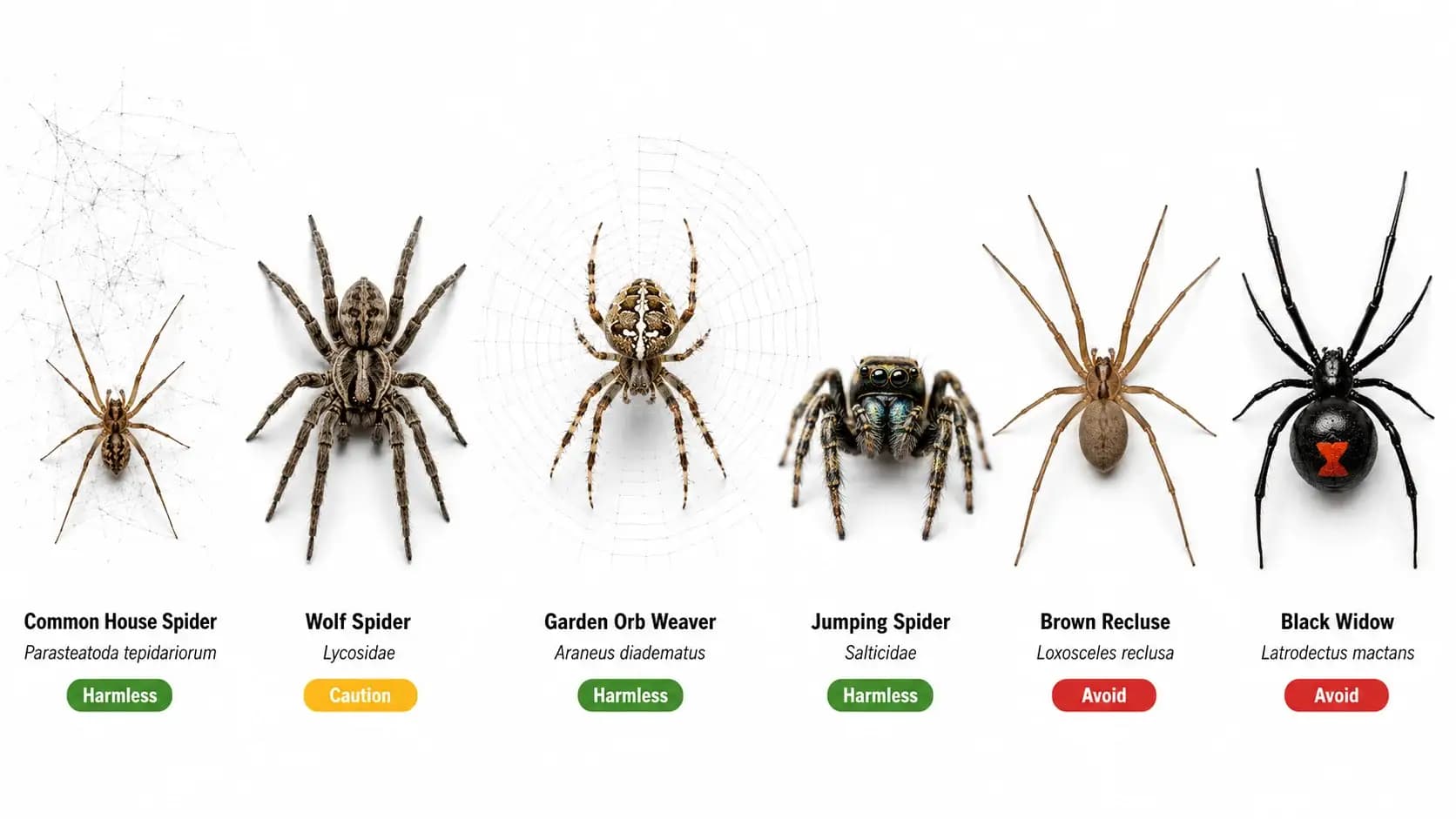
Spider Identification Chart: Common Spiders at a Glance
Beyond brown recluse and black widow, a handful of other named species come up often in searches. The spider identification chart below gives a fast side by side comparison, and our guide to 25 common types of spiders covers many more with pictures.
| Species | Color | Size | Web Type | Danger Level |
|---|---|---|---|---|
| House spider | Brown, tan | 0.25 to 0.5 in | Cobweb, indoor corners | Harmless |
| Wolf spider | Gray, brown | 0.5 to 1.4 in | No web, ground hunter | Harmless |
| Jumping spider | Black, iridescent | 0.2 to 0.75 in | No web, ambush hunter | Harmless |
| Garden orb weaver | Yellow, brown, striped | 0.5 to 1 in | Orb, circular | Harmless |
| Brown recluse | Pale to medium brown | 0.25 to 0.5 in | Irregular retreat web, wanders at night | Avoid |
| Black widow | Glossy black, red marking | 0.5 in | Cobweb, low to ground | Avoid |
| False widow | Dark brown, cream marking | 0.2 to 0.4 in | Cobweb | Caution |
| Hobo spider | Brown, chevron pattern | 0.25 to 0.5 in | Funnel | Caution |
| Funnel web spider | Black, glossy | 0.4 to 1.8 in | Funnel with tube retreat | Avoid, primarily Australia |
How to Identify Spider Egg Sacs
Shape, silk texture and location together identify most egg sacs without needing to see the spider itself.
Garden orb weaver
A round white silk sac suspended within a web belongs to a garden orb weaver.
Wolf spider
A disc shaped, papery brown sac is characteristic of a wolf spider, which is unusual among spiders in that the female carries the sac attached directly to her spinnerets at the tip of her abdomen rather than leaving it in a web. A spider with a white or tan ball on its back end is almost always a female wolf spider carrying her egg sac, and after hatching, the spiderlings ride on her back.
Black widow
A teardrop shaped tan silk sac found in a tangled cobweb near the ground points to a black widow.
Spider Mites: Why They Are Not Actually Spiders
Not a true spider
Spider mites are arachnids, in the same broad group as true spiders, but they belong to a completely different family and are not spiders in the sense most people searching this term actually mean. They are barely visible without magnification and are usually noticed first as fine webbing on the underside of plant leaves, along with tiny yellow or white speckling across the leaf surface where the mites have been feeding. That fine webbing is the source of the name confusion, since it resembles a true spider's web at a much smaller scale. Spider mites damage houseplants and garden plants but present no bite risk to humans. Our guide to garden pest signs shows how to tell their damage from other plant pests.
Can Google Identify a Spider From a Picture? How AI Tools Compare
Google Lens identifies common, well photographed spider species reasonably well using image matching, so yes, Google can identify a spider from a picture in many cases. But it does not provide a danger assessment, and that gap matters more here than with most other identification tasks, since a small number of spider species carry genuine medical significance. A dedicated spider identifier is built specifically to close that gap, returning a danger level alongside the species name every time.
How the Spider Identifier Works: AI Analysis
The model looks at the same visible clues described in Step 2, so clearer photos give more reliable matches. Every result is cross referenced against the World Spider Catalog, the most comprehensive taxonomic reference for spider species, maintained by the Natural History Museum Bern, which lists more than 50,000 described spider species. Each quarter the model is tested again on a fixed set of verified spider photographs.
How results are checked for accuracy
Every species name matches the World Spider Catalog, and safety ratings follow published guidance from public health and university sources. Species of medical concern, such as widows and recluses, always show an Avoid badge with next steps, and a hard to read photo gets a request for a clearer one.
Danger ratings are informational, not a personal safety guarantee. See our AI Use Disclosure and medical notice.
More Identification Tools
Free AI-powered tools for every identification need — bugs, bites, spiders, and insects.
Bug Identifier
Upload a photo of any bug and get the species name, danger level, and what to do — in seconds. Free, no sign-up required.
Use Bug Identifier →Bug Bite Identifier
Find out what bit you, how dangerous it is, and what to do next. Covers mosquito, flea, tick, spider, and bed bug bites.
Use Bug Bite Identifier →Insect Identifier
Identify butterflies, beetles, flies, ants, wasps, bees, moths, and all true insects by photo in seconds.
Use Insect Identifier →Frequently Asked Questions About Spider Identification
Sources and References
All species identification, classification, and safety guidance on this page draws from the following authoritative sources:
- World Spider Catalog, Natural History Museum Bern.
- Integrated Taxonomic Information System.
- Royal Entomological Society.
- Mayo Clinic. Black Widow Spider Bite.
- UC San Diego Health. Spider Bites.
- University of Florida Entomology and Nematology Department.
- US Centers for Disease Control and Prevention, NIOSH. Venomous Spiders.
- University of California Statewide IPM Program. Brown Recluse and Other Recluse Spiders.
For treatment steps if you have been bitten, see the Bug Bite Identifier page. This page covers species identification only.