Insect IdentifierUpload a Photo and Find Out Exactly What Insect This Is
Our free AI insect identifier tells you what insect this is from a single photo. Get the species name, insect order, habitat and a harmless, caution or avoid safety rating in seconds. It covers insect identification for bugs, beetles, bees, ants, flies, spiders and other lookalikes, garden pests, insect eggs and larvae, worldwide.
1,000+
Insect Species
14
Visual Features Analyzed
Seconds
Fast AI results
Upload Your Insect Photo
Get an instant AI identification: species, habitat and a harmless, caution or avoid safety rating.
Drop your insect photo here
or tap to upload from camera or gallery
Supports JPG, PNG, WEBP, HEIC (iPhone) · Max 10MB · Free · No sign-up required
How to Identify an Insect: Upload a Photo or Use These 4 Features
The fastest way to identify an insect is to upload a clear photo to a free AI insect identifier. If a photo is not possible, four features narrow most insects down to one or two likely species before anything else is needed: leg count, wings, body color and shape, and where it was found.
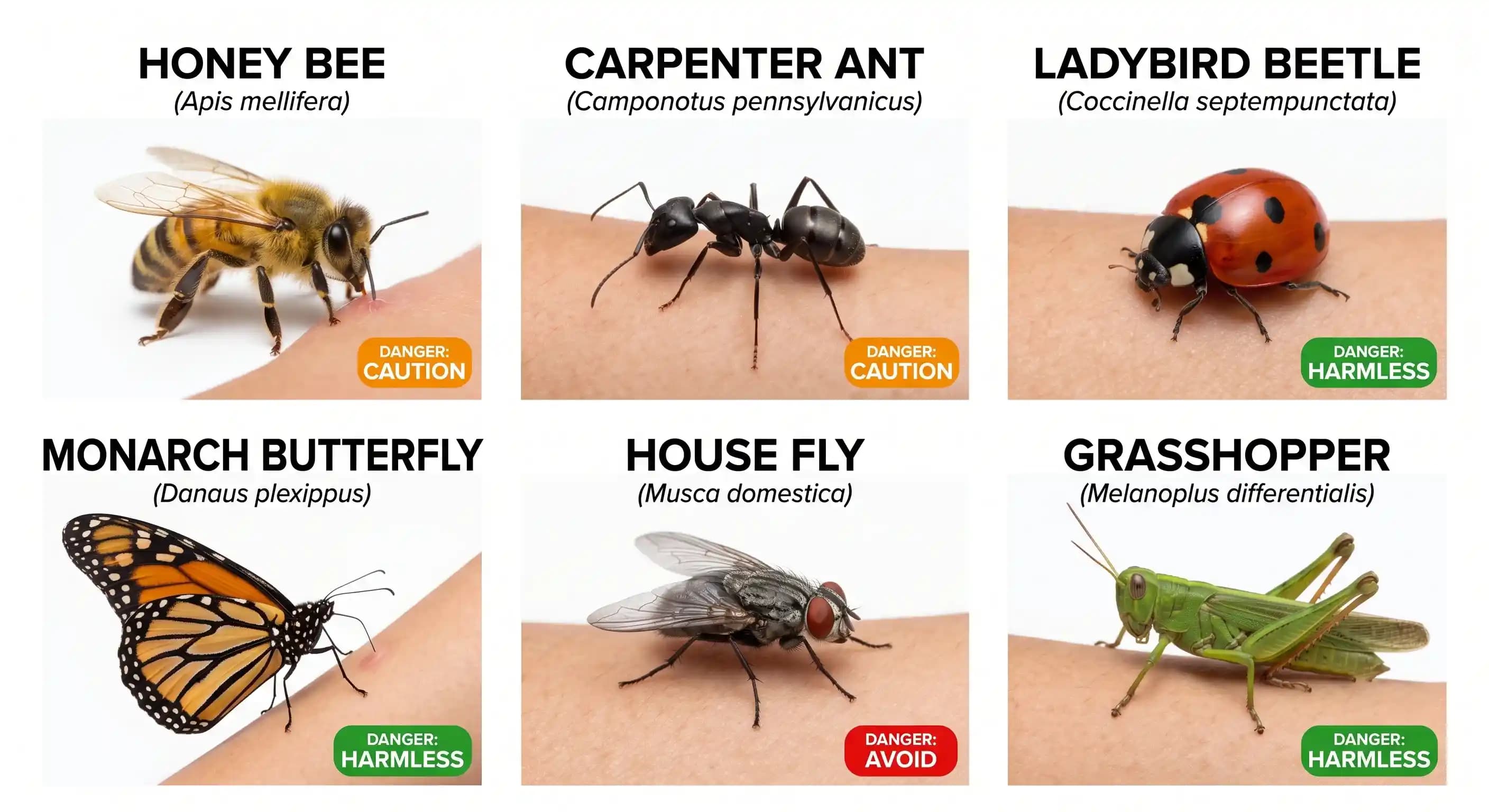
Photograph the insect clearly
Get within 15 to 20 centimeters (6 to 8 inches) of the insect so the whole body fills the frame. Tap your screen to focus before taking the shot. Shoot in daylight without flash, which bleaches the color detail that identification depends on. Where possible, take one photo from above and one from the side, since wing pattern and leg position are often clearer from a side angle.
On an iPhone 13 Pro or later, tap the flower icon in the camera app to switch on macro mode. This produces sharper close up detail for very small insects such as gnats, mites and aphids that standard camera mode tends to blur. Android users can achieve a similar result using the dedicated macro lens included on most mid range and flagship phones released after 2021.
Upload to the free AI insect identifier
Once uploaded, the AI reads the same visual features checked in field identification: body shape, leg count, wing presence and vein pattern, antennae type, color banding, body segmentation and size ratio. If location data is included, habitat context sharpens the result further, since many similar looking species live in different regions or environments.
Read your results
The result card returns the common name, scientific name, insect order, typical habitat and a safety badge marked Harmless, Caution or Avoid. Species that can bite or sting link through to the Bug Bite Identifier. This safety badge is the fastest way to know if an insect found in the home or garden needs any action at all.
How to identify an insect without a photo
When a photo is not possible, four checks cover most cases. First, count the legs: 6 legs confirms an insect, 8 legs points to a spider or tick, and more than 8 points to a centipede or millipede. Second, check for wings, and if present, how many pairs. Third, note the body color and pattern. Fourth, note where it was found, since habitat is often the fastest second filter after basic shape. These four checks together are usually enough to narrow an unknown insect to a small, identifiable group. Our guide to insect anatomy and body parts shows each feature on a labeled diagram.
What Is This Insect? The Difference Between Insects, Bugs, and Spiders
Informally, bug and insect mean the same thing, which is why "bug vs insect" is such a common question. Scientifically, true bugs are a specific insect order called Hemiptera, which includes aphids, stink bugs and cicadas, identified by a piercing mouthpart used to suck plant sap or blood. Beetles, bees, flies, ants and moths are not true bugs in the scientific sense, even though they are commonly called bugs in everyday language. Every true bug is an insect, but not every insect is a true bug. Our guide to whether a butterfly is an insect runs through more common examples.
Is a spider an insect? No. Spiders belong to a separate class called Arachnida, along with ticks, mites, scorpions and tarantulas. The clearest difference between a spider and an insect: insects have 6 legs and a three part body divided into head, thorax and abdomen, while spiders have 8 legs and only two body sections, with no wings and no antennae. Both are animals and both are arthropods, as our guide to whether an insect is an animal explains. For eight legged finds, use the Spider Identifier.
| Group | Legs | Body Sections | Wings | Antennae | Common Examples |
|---|---|---|---|---|---|
| True Insects (Insecta) | 6 | 3 (head, thorax, abdomen) | Usually present | Yes | Beetles, bees, ants, flies, moths |
| True Bugs (Hemiptera) | 6 | 3 | Usually present | Yes | Aphids, stink bugs, cicadas, bed bugs |
| Spiders (Arachnida) | 8 | 2 | None | No | Garden spiders, black widow, brown recluse |
| Ticks and Mites (Acari) | 8 (adult) | 1 fused | None | No | Deer tick, dust mite, chigger |
| Centipedes (Chilopoda) | 1 pair per segment | Many segments | None | Yes | House centipede, garden centipede |
| Millipedes (Diplopoda) | 2 pairs per segment | Many segments | None | Yes | Garden millipede, greenhouse millipede |
Identify House Insects: The Most Common Insects Found Indoors
Finding an unfamiliar insect indoors is one of the most common reasons people search for household insect identification. Most house insects fall into a small number of recognizable groups. For a full room by room guide, see the ScanaBug home page and our household insect identification chart.
Tiny black insects in the house: the 5 most common species
The five most common tiny black insects indoors are carpet beetle larvae near wool and stored fabric, fungus gnats hovering over houseplant soil, fruit flies with red eyes around ripe produce, drain flies with fuzzy wings near sinks, and black garden ants trailing in straight lines toward food. Movement pattern is often the fastest clue, since ants move in purposeful lines while beetles wander.
How to identify small flying insects in your home
To identify a flying insect, count the wings first. Flies, gnats and mosquitoes have one pair of wings, while bees, wasps and moths have two pairs, and beetles fly with their hard wing covers raised. Our bumblebee identification guide shows how to tell bees from their lookalikes. Indoors, location is the next clue: fungus gnats hover near houseplant soil, fruit flies near ripening produce, drain flies near sinks and whiteflies rise from the undersides of plant leaves. Our guide to flying bugs in the house covers each one in detail.
How to Identify Insect Eggs, Larvae, and Cocoons
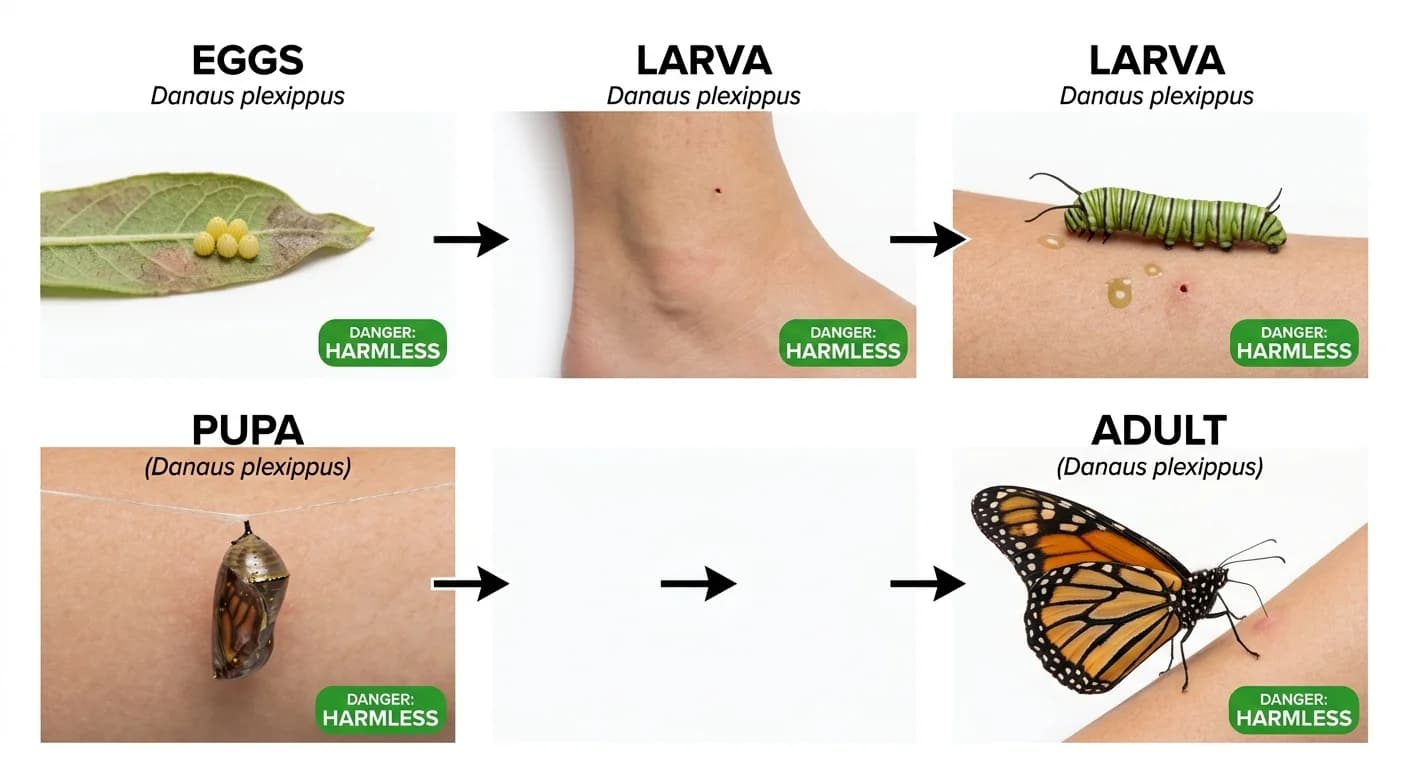
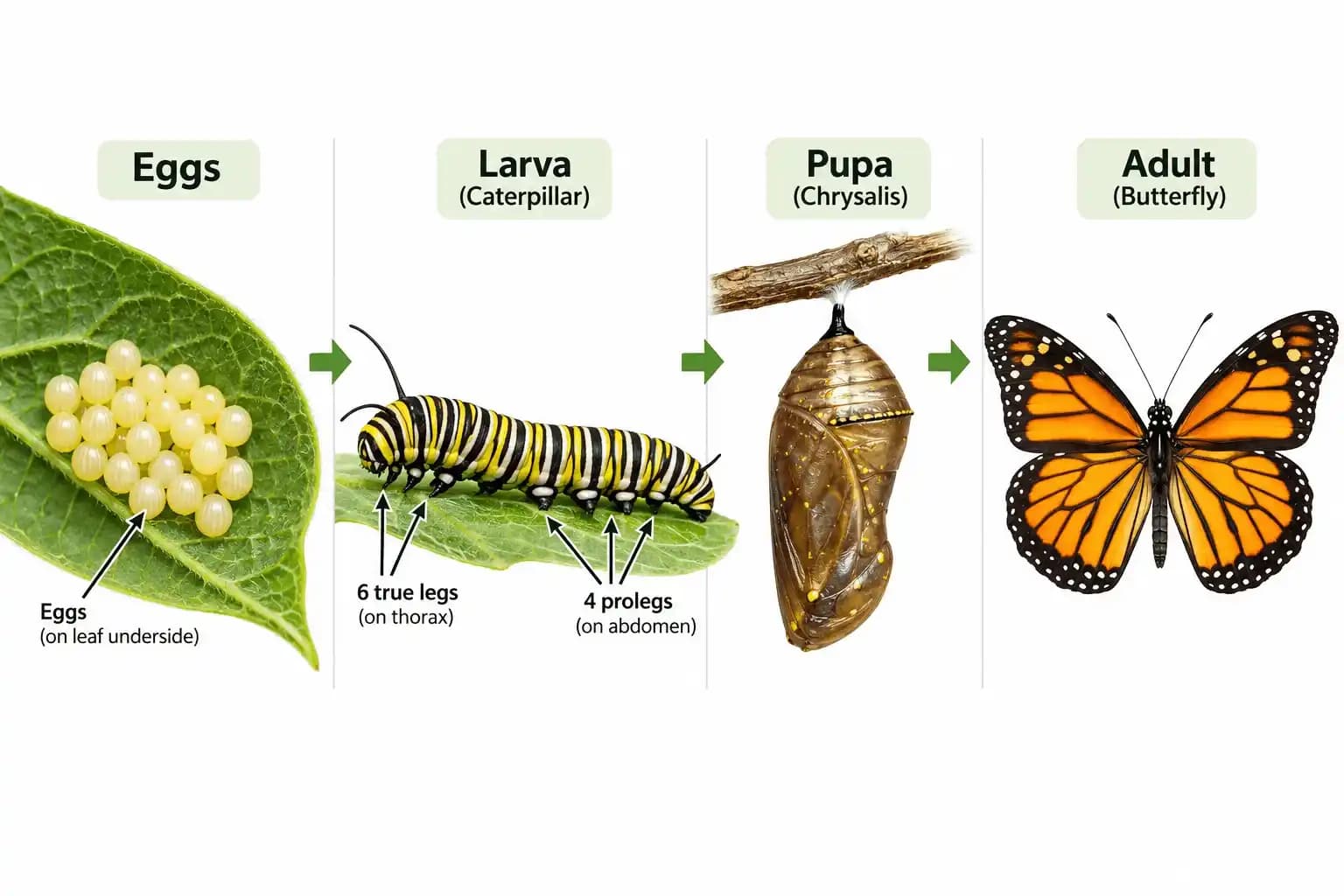
Insect eggs, larvae and cocoons are identified differently from adult insects, since color, texture and location matter more than leg count or wing shape at these early life stages. Insects grow through either complete metamorphosis (egg, larva, pupa, adult) or incomplete metamorphosis (egg, nymph, adult), as our guide to the insect life cycle explains.
Identify insect eggs: what they look like by location and color
Underside of leaves
Eggs laid on the underside of leaves usually belong to whiteflies, butterflies, moths or leaf beetles.
In soil
Eggs found in soil are typically from ground beetles, crane flies or grasshoppers.
Silk or foam on plant stems
Clusters of eggs held together in silk or foam on plant stems come from lacewings, true bugs or praying mantises.
Color is a useful second filter: pale white or cream eggs are common across many species, while bright orange or yellow eggs usually belong to beetles. Some insect eggs look like seeds, such as the hard, seed shaped eggs of stick insects. Spider egg sacs are sometimes mistaken for insect eggs, but spiders are arachnids, not insects, as covered in the table above.
The insect egg identification chart below matches common types of insect eggs to the insects that lay them.
| What the eggs look like | Where you find them | Likely insect |
|---|---|---|
| Tiny pale white or cream ovals, often in small circles | Underside of leaves | Whiteflies |
| Single small cream or pale green eggs with fine ridges | Host plants such as milkweed or cabbage | Butterflies and moths |
| Bright yellow or orange oval eggs standing upright in clusters | Underside of leaves | Leaf beetles, such as the Colorado potato beetle |
| Pale green or white eggs on thin silk stalks | Leaves and stems | Green lacewings |
| Barrel shaped eggs in neat rows, often bronze or pale | Leaf surfaces | Many true bugs |
| Tan, foamy mass that hardens around a twig | Twigs, stems and fences | Praying mantis egg case |
| Gray, mud like smear about 2.5 to 4 cm long | Tree bark, stone and vehicles | Spotted lanternfly egg mass |
| Hard, brown or gray eggs that look like seeds | Soil under shrubs | Stick insects |
| Brown, purse shaped capsule about 6 to 10 mm long | Behind appliances and in cabinets | Cockroach egg case |
| Tiny pearly white eggs about 1 mm long | Mattress seams and bed frames | Bed bugs, see our bed bugs guide |
Insect eggs in the house: small white, yellow and brown eggs indoors
Small white insect eggs in the house usually belong to pantry moths, clothes moths, carpet beetles or bed bugs, and the place you find them is the best clue. Eggs in flour, cereal or dried food point to pantry moths or beetles, eggs on wool or stored fabric point to clothes moths or carpet beetles, and eggs in mattress seams point to bed bugs. Brown, oval capsules behind appliances are cockroach egg cases. Our guide to insect egg and larvae identification covers more household insect egg identification examples.
Insect larvae identifier: grubs, caterpillars, maggots, and nymphs
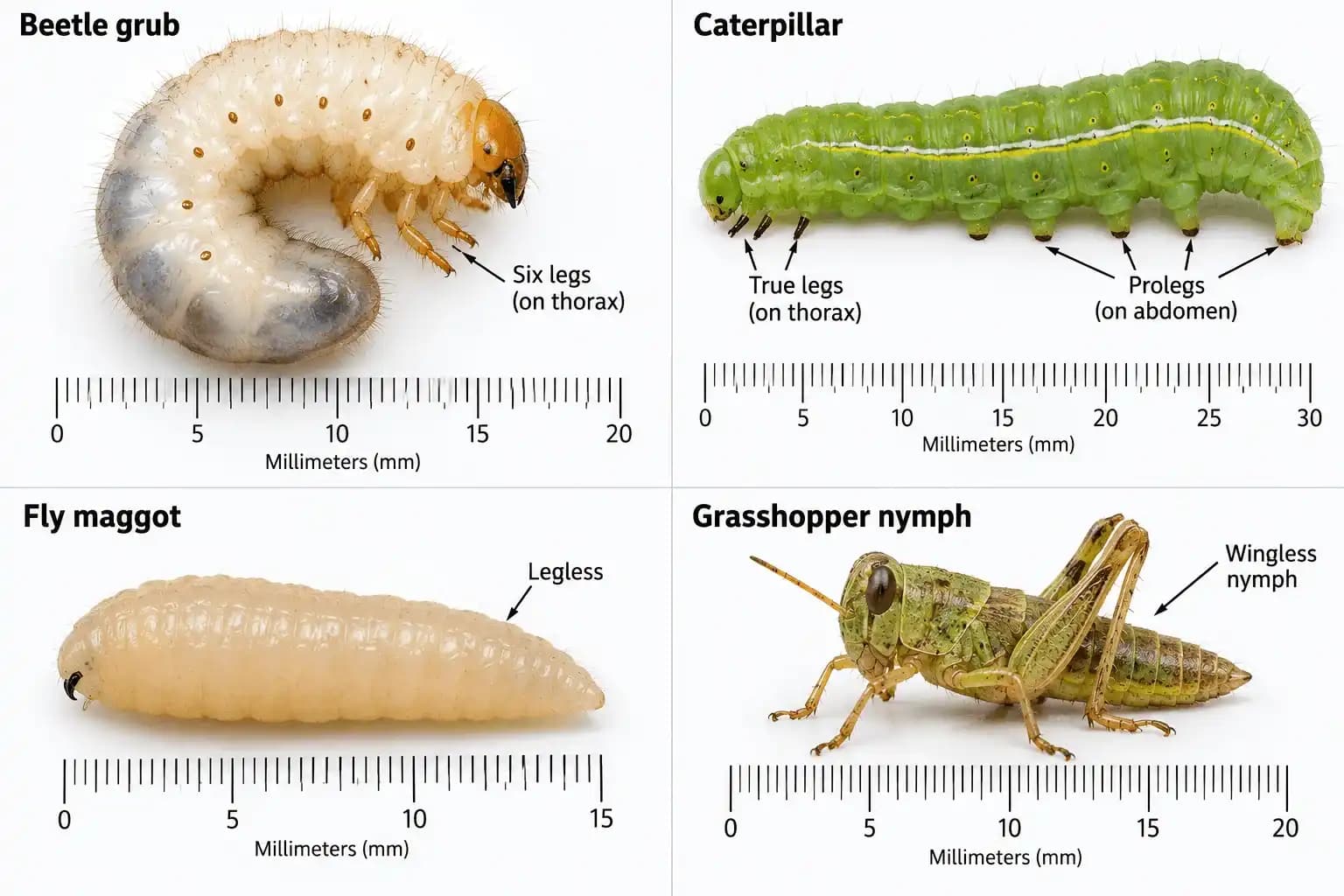
Larvae fall into four recognizable forms.
Grubs
Grubs are C shaped, white and have 6 short legs near the front of the body, and are usually found in soil, since they are the larval stage of beetles.
Caterpillars
Caterpillars have 6 true legs at the front plus up to 10 fleshy prolegs along the rest of the body, and feed on plant leaves as the larval stage of moths and butterflies. Our caterpillar identification guide shows common types and which ones sting.
Maggots
Maggots are pale, legless and found in decaying organic matter, since they are fly larvae.
Nymphs
Nymphs look like miniature wingless versions of the adult insect and belong to grasshoppers, crickets and true bugs, which develop gradually rather than through a full larva to pupa transformation.
How to identify insect cocoons and egg sacs
Material and location together identify most cocoons and egg cases.
Smooth silk cocoons
Smooth silk cocoons attached to twigs or surfaces belong to moths.
Foam like egg masses
Foam like egg masses found in soil or on plant stems belong to grasshoppers or praying mantises.
Hardened earthen tubes
Hardened earthen tubes fixed to exterior walls are built by mud dauber wasps to house their eggs.
Household casebearer case
A small, flat, gray case on an indoor wall in a humid home is often the case of a household casebearer moth larva, which drags its case as it moves.
Insect egg sacs vs spider egg sacs
Spider egg sacs are round balls of silk, usually white, cream, tan or brown, and often guarded by the mother or hung in a web. Insect egg cases look different: a praying mantis case is foamy and hardened, a cockroach case is a brown capsule, spotted lanternfly eggs are covered in a gray, mud like layer, and spongy moth egg masses are tan, fuzzy patches on bark. If the case is made of loose silk and sits in a web, it is almost certainly a spider egg sac, and the Spider Identifier can confirm the species.
Identifying Garden Insects: Pests, Beneficial Insects, and Wood Boring Species
Garden insects fall broadly into pests that damage plants and beneficial insects that support a healthy garden, such as pollinating bees and predatory beetles that feed on aphids. Lawn insects such as white grubs feed on grass roots underground, as our guide to lawn grubs explains. Three garden categories cause the most identification confusion: scale insects, wood boring insects and beetles.
Identifying scale insects: what they look like and why they are easy to miss
Scale insects are often mistaken for plant damage, since adults have no visible legs or antennae and appear as small bumps on stems and leaves. Soft scale forms brown, waxy, raised bumps, while armored scale forms flat, hard, circular shells on bark. For scale insect identification by type and treatment, see our scale insect guide.
Identifying wood boring insects: how to spot the signs before serious damage
Wood boring insects are usually identified by the damage they leave behind before the insect itself is ever seen.
Bark beetles
Bark beetles leave small circular exit holes 1 to 3 millimeters wide, often surrounded by fine sawdust.
Longhorn beetles
Longhorn beetles, among the most common wood borer insects, leave larger oval exit holes between 4 and 8 millimeters.
Wood boring wasps
Wood boring wasps leave round holes with little to no sawdust nearby.
Termites
Termites are the exception, since their damage includes visible mud tubing along foundations or walls rather than clean exit holes, which is the clearest way to rule termites in or out.
Identifying beetles: wing covers, antennae and a quick photo check
Beetles are the easiest large insect group to recognize: their hard front wings, called elytra, close over the back and meet in a straight line down the middle. Antennae then narrow the type. Clubbed antennae point to scarab beetles, very long antennae to longhorn beetles, elbowed antennae with a long snout to weevils and comb like antennae to click beetles and some fireflies. For beetle insect identification by photo, upload a clear picture from above to the tool at the top of this page. Our beetle identification guide covers common types, black beetles in the house and weevils.
Tiny white insects on plants
Small white insects on plants are usually mealybugs, whiteflies, woolly aphids or spider mites. Mealybugs look like slow moving cotton tufts on stems. Whiteflies are tiny white flying insects that rise in a cloud when you shake the plant. Woolly aphids cluster under white waxy strands, and spider mites, which are arachnids rather than insects, leave fine webbing and pale speckles on leaves. Checking the undersides of leaves with a hand lens usually settles which white insect you have.
Identify Insects by Sound: Which Insects Make Noise and What Each Sound Means
Several common insects can be identified by sound alone, without ever seeing the insect that made it. This is a genuine and long used entomological identification method, not a novelty.
Cricket vs katydid vs cicada: how to tell insect sounds apart
Cricket · heard at night
A regular, rhythmic chirping heard at night is almost always a cricket. Crickets produce this sound through stridulation, rubbing specialized ridges on their wings together. Our cricket identification guide explains why crickets chirp and how chirp speed changes with temperature.
Katydid · heard in the evening
A louder, more complex call heard in the evening usually comes from a katydid, which produces sound the same way but with a more varied rhythm and pitch.
Cicada · heard by day
A loud, continuous buzzing or droning heard from trees during daylight hours is a cicada, unusual among insects because it produces sound using a vibrating membrane called a tymbal located in the abdomen, not through its wings at all.
Grasshopper
Grasshoppers produce a quieter scratching sound by rubbing their hind legs against their wings, distinct from all three of the above.
Most insect sounds at night come from crickets and katydids, while cicadas are the loudest insects in the world. The University of Florida Book of Insect Records lists an African cicada, Brevisana brevis, at about 107 decibels measured 50 centimeters away, louder than a lawnmower. To reduce insect noise at night indoors, close windows and switch outdoor lights to warm yellow bulbs, which attract fewer singing insects to the house.
Identify Insect Droppings, Nests, and Evidence
Homeowners typically find evidence of an insect before they ever see the insect itself, which makes evidence based identification genuinely useful and widely searched. For nests, see our guide to bug nests and stings.
What do insect droppings look like?
Termite droppings (frass)
Termite droppings, technically called frass, are tiny six sided pellets close to wood color, about 1 millimeter long, and found in small neat piles directly below infested wood.
Cockroach droppings
Cockroach droppings are dark cylinders or dots ranging from 1 to 3 millimeters, most often found along walls and behind kitchen appliances.
Caterpillar droppings
Caterpillar droppings are noticeably larger green or brown cylinders found on the ground directly beneath the plant they are feeding on.
Sawdust (wood boring beetles)
Fine, powdery sawdust found below a wooden surface without any visible pellets points to wood boring beetles rather than termites, since beetle damage produces dust rather than formed droppings.
Insect frass: droppings on plants and in the house
Insect frass is the scientific name for insect poop, and it is often the first clue to what is living in a plant or a room. On plants, dark pellets on leaves or on the ground below usually mean caterpillars are feeding above. Sticky, shiny spots are not droppings at all but honeydew from sap feeders such as aphids and scale insects. In the house, the size, shape and location of the droppings narrow the insect quickly, as the chart below shows.
| Insect | What the droppings look like | Where you find them |
|---|---|---|
| Drywood termites | Hard, six sided pellets about 1 mm long, like sand or coffee grounds | Small piles under tiny holes in wood |
| Cockroaches | Black specks like pepper, or small ridged cylinders up to 3 mm | Along walls, in cabinets and behind appliances |
| Caterpillars | Green, brown or black barrel shaped pellets | On leaves and on the ground under plants |
| House flies | Tiny dark specks | On windows, walls and light fixtures |
| Bed bugs | Dark spots like marker dots that smear when wet | Mattress seams and bed frames |
| Carpet beetle larvae | Fine, sand like grains with shed skins | Closets, rugs and stored fabrics |
Insect Species: Which Are Most Common, Which Are Endangered
Scientists have described about 900,000 to 1 million insect species, roughly 80 percent of all known animal species, and the Smithsonian estimates that around 10 quintillion individual insects are alive at any one time. The largest insects can be surprisingly big, as our guide to the biggest insects in the world shows.
Beetles
Beetles form the largest insect order on Earth, with more than 400,000 described species, making up roughly 40 percent of all known insects.
Ants
Ants are the most numerous by individual count, with an estimated 20 quadrillion individual ants alive at any given time.
Monarch butterfly
On the opposite end, several well known species face serious population decline. The monarch butterfly, the official insect of several states in our list of state insects, has lost an estimated 80 percent of its population over the past two decades due to habitat loss along its migration route.
Rusty patched bumblebee
The rusty patched bumblebee is listed as Critically Endangered on the IUCN Red List and as endangered in the United States, one of the first bees in North America to receive protection.
Tracking which species are common versus endangered matters beyond curiosity, since it shapes which insects are safe to remove from a garden and which deserve protection.
Can Google Identify an Insect from a Photo? How a Dedicated AI Tool Compares
Google Lens identifies common adult insects from photos using image matching against a large indexed image database, and it performs well for widely photographed species such as butterflies, common beetles, and honey bees. It returns weaker, more generic results for larvae, eggs, and less commonly photographed species, and it does not assess whether an insect is harmful, provide habitat detail, or identify life stages. A dedicated AI insect identifier fills these specific gaps, since it is trained to recognize the exact features that matter for practical identification rather than general visual similarity.
| Feature | Google Lens | This AI Insect Identifier |
|---|---|---|
| Primary purpose | General visual image matching | Purpose built insect identification |
| Species coverage | Strong for common adult species | Broad coverage including uncommon species |
| Egg and larvae identification | Limited, often inconclusive | Dedicated coverage of life stages |
| Harmful or harmless assessment | Not provided | Provided with every result |
| Habitat information | Not provided | Included in every result |
| Sound identification note | Not supported | Covered separately in this guide |
| Droppings and evidence ID | Not supported | Covered separately in this guide |
| App download required | No | No |
| Free to use | Yes | Yes |
| Taxonomy check | Not disclosed | Cross checked against ITIS and GBIF |
How the Insect Identifier Works: AI Technology
From every uploaded photo the model extracts 14 visual features, the same ones listed in Step 2 plus habitat context where available. Every result is cross referenced against the Integrated Taxonomic Information System (ITIS) and the Global Biodiversity Information Facility (GBIF), two of the most widely used taxonomic reference databases maintained by government and international research bodies. The model is tested again every three months on a fixed set of confirmed insect photographs to track accuracy over time.
How results are checked for accuracy
Results are checked against established taxonomic databases rather than general image search, and every species page uses names that match ITIS and GBIF records. Species that can bite or sting always show a safety badge with next steps, and a blurry photo gets a request for a clearer one rather than a guess.
Safety badges are informational, not a personal safety guarantee. See our AI Use Disclosure and, for stings or bites, medical notice.
More Identification Tools
Free AI-powered tools for every identification need — bugs, bites, spiders, and insects.
Bug Identifier
Upload a photo of any bug and get the species name, danger level, and what to do — in seconds. Free, no sign-up required.
Use Bug Identifier →Bug Bite Identifier
Find out what bit you, how dangerous it is, and what to do next. Covers mosquito, flea, tick, spider, and bed bug bites.
Use Bug Bite Identifier →Spider Identifier
Identify any spider from a photo. Built to answer the one question that matters: is this spider dangerous? Covers spiders found worldwide.
Use Spider Identifier →Frequently Asked Questions About Insect Identification
Sources and References
All species identification, classification, and life stage guidance on this page draws from the following authoritative sources:
- Smithsonian Institution, National Museum of Natural History. Department of Entomology, Collections Access.
- Penn State Extension. Insect Identification and Control.
- University of Florida Entomology and Nematology Department.
- Triplehorn, C. A. and Johnson, N. F. Borror and DeLong's Introduction to the Study of Insects. WorldCat library record search.
- Smithsonian Institution, National Museum of Natural History. Numbers of Insects (Species and Individuals), BugInfo.
- University of Florida Book of Insect Records. Chapter 24: Loudest.
- University of California Statewide IPM Program. Drywood Termites.
- Penn State Extension. Spotted Lanternfly.
- Utah State University Extension. Beneficial Insects: Mantids.
- American Museum of Natural History. Metamorphosis in Arthropods.