June Bug: Identification, Types and Pictures
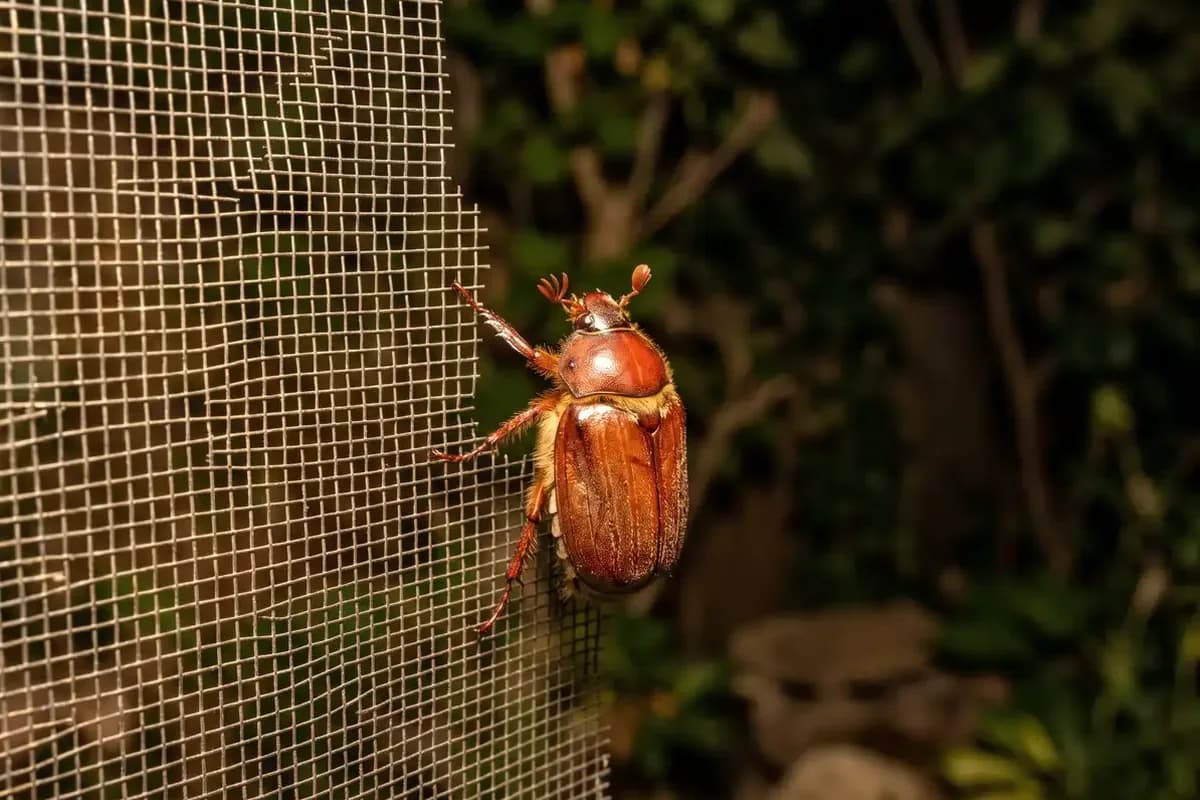
A June bug is a stout, reddish brown to almost black beetle about 1/2 to 1 inch (1.3 to 2.5 cm) long that flies to porch lights on early summer nights. The name covers several scarab beetles, mainly the May and June beetles of the genus Phyllophaga, and is also used for the green June beetle, the ten lined June beetle and the European cockchafer, or May bug. They are harmless to people. This guide shows how to identify each type, what they eat and why they seem to fly straight at you.
What Does a June Bug Look Like?
The common type is an oval, heavy bodied beetle, reddish brown to dark brown, with a shiny back and spiny legs.
- Size: the University of Wisconsin notes adults are about 1/2 to 1 inch (1.3 to 2.5 cm) long.
- Colour: reddish brown to almost black.
- Shape: rounded and solid, like a large coffee bean.
- Antennae: short, ending in a small club of flat plates that can fan out.
- Wings: hard wing covers on top, with thin flying wings folded underneath.
- Behaviour: active after dusk, clumsy in flight and strongly drawn to lights.
These are scarab beetles, so they have the typical scarab clubbed antennae. That detail helps tell them apart from cockroaches, which have long, thread like antennae.
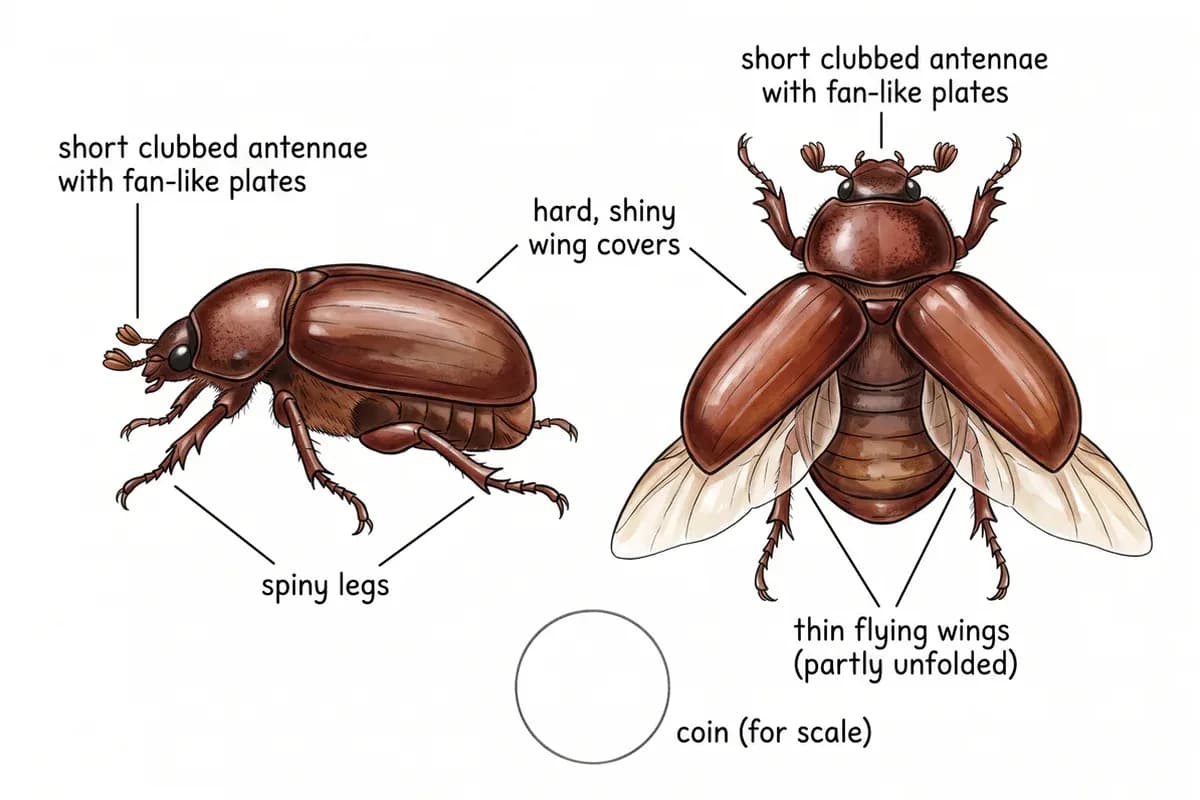
Types of June Beetles
Several different beetles share the name, and colour is the quickest way to tell them apart. Sizes are from the University of Wisconsin, Penn State Extension, Colorado State University and the Natural History Museum, London.
| Type | Scientific name | Size | Colour and markings | Where |
|---|---|---|---|---|
| May and June beetles | Phyllophaga species | 1/2 to 1 in (1.3 to 2.5 cm) | Reddish brown to almost black, shiny | North America |
| Green June beetle | Cotinis nitida | 3/4 to 1 in (1.9 to 2.5 cm) | Velvety green to dull brown with yellow orange edges, metallic green underside | Eastern and central US |
| Figeater beetle | Cotinis mutabilis | About 1 in (2.5 cm) | Bright metallic green | Southwestern US and Mexico |
| Ten lined June beetle | Polyphylla decemlineata | 22 to 30 mm (about 1 in) | Brown with white stripes along the back | Western North America |
| Cockchafer (May bug) | Melolontha melolontha | 2.5 to 3 cm (about 1 in) | Reddish brown wing cases, white triangles on the sides | Europe |
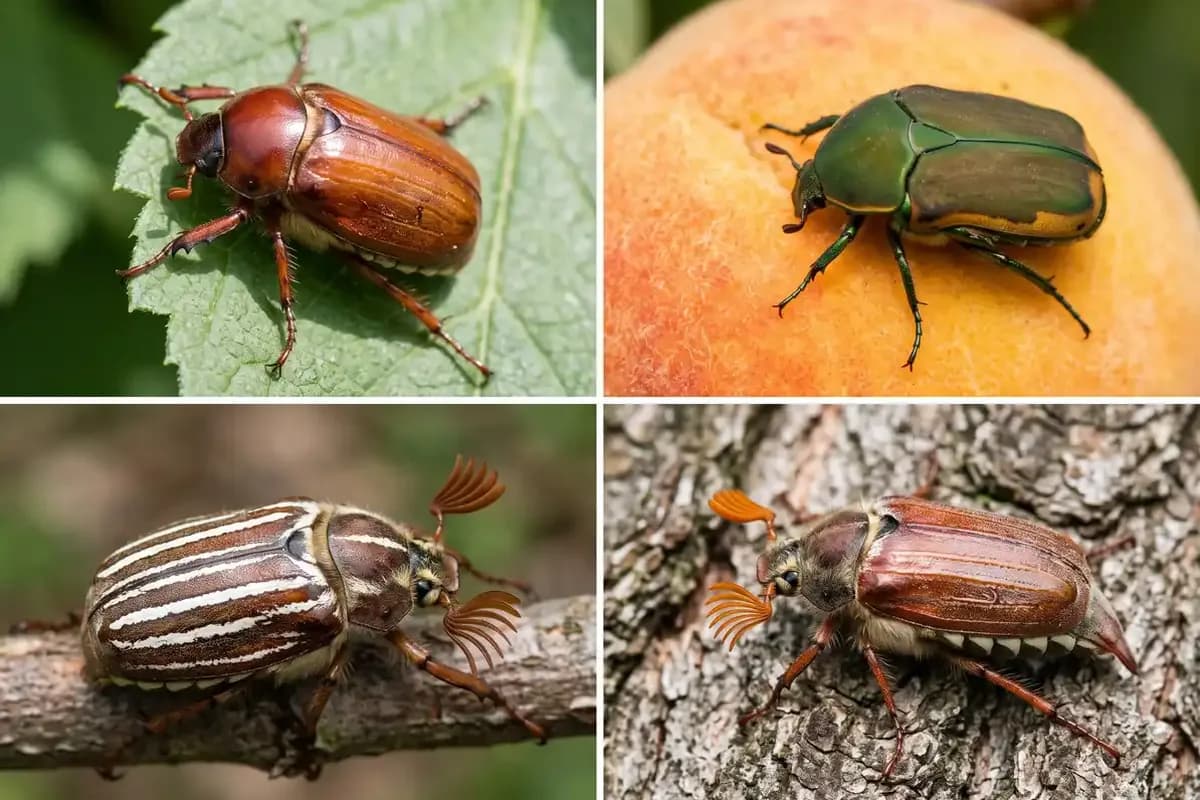
Green June Beetle and Figeater
The green June beetle (Cotinis nitida) is a larger, flatter beetle that is velvety green on top and shiny metallic green or gold underneath.
- Size and colour: Penn State Extension notes adults are 3/4 to 1 inch (1.9 to 2.5 cm) long, velvety green to dull brown with yellow orange edged stripes.
- Small horn: a small flat horn on the head.
- Daytime flier: unlike brown June beetles, it flies by day, mostly in July, with a loud buzz.
- Fruit lover: Penn State Extension notes it is called the fig eater because it likes ripe figs and other thin skinned fruit.
In the Southwest, a close relative, the figeater beetle (Cotinis mutabilis), is bright metallic green and also feeds on ripe fruit. Both are sometimes given the same green nickname.
Ten Lined June Beetle
The ten lined June beetle (Polyphylla decemlineata) is a large brown beetle with bold white stripes running down its back.
- Size: Colorado State University notes adults are 22 to 30 mm (about 1 in) long, among the largest scarabs in Colorado.
- Antennae: males have large, fan like antennae. Females have small ones.
- Sound: Colorado State University notes adults hiss loudly when disturbed, by pushing air out of their breathing holes.
- When: adults fly from late June through early August, and males are strongly drawn to lights.
Despite the hissing, it is harmless. Its grubs feed on roots but rarely cause serious damage.
Cockchafer, the European May Bug
The cockchafer (Melolontha melolontha), also called the May bug or maybug, is the European version of the brown June beetle.
- Look: the Natural History Museum notes it is 2.5 to 3 cm (about 1 in) long, hairy, with reddish brown wing cases, white triangles along the sides and orange fan like antennae.
- When: adults fly at dusk on warm evenings, from late April and May.
- Harmless: the pointed tip of the abdomen is used by females to lay eggs in soil. It does not sting.
- Grubs: live underground for three to four years, eating plant roots.
What Do June Bugs Eat?
Adults eat leaves, flowers or ripe fruit, depending on the type, while their grubs eat plant roots underground.
- May and June beetles: the University of Maine notes adults feed on the leaves of trees and shrubs such as oaks and maples, usually causing only small holes.
- Green June beetle and figeater: ripe, thin skinned fruit such as figs, peaches and grapes.
- Grubs: C shaped white grubs in soil that eat grass and plant roots. The University of Wisconsin notes most species take about three years to complete their life cycle.
Grubs can damage lawns, but this guide focuses on the adults. For garden feeding damage, see our garden insect guide.
Are June Bugs Dangerous?
No. They do not bite or sting people, and they do not spread disease.
- Why they fly into you: they are clumsy fliers drawn to lights, so near porch lights they bump into people, windows and screens. They are not attacking.
- Are they blind? No. They have working eyes, but bright lights confuse their flight at night.
- Clingy legs: spiny legs can grip skin or hair, which feels alarming but does no harm.
- Pets: a dog or cat that eats one may vomit, but they are not poisonous.
June Beetles vs Lookalikes
Several beetles and even cockroaches are mistaken for them.
- Japanese beetle: smaller, metallic green with copper wing covers and white tufts along the sides, active by day.
- Dung and other scarabs: similar shape but often black or with horns.
Cockroaches have flat bodies, long thin antennae and run fast. See our guide to the water bug, the large roach people often find near drains. If you are not sure, the Bug Identifier can compare your photo with common beetles. For broader insect groups, the Insect Identifier is also available.
Life Cycle in Brief
These beetles spend most of their lives underground as grubs and only a few weeks as flying adults.
- Eggs: females lay eggs in soil, often in lawns and grassy areas.
- Grubs: C shaped, cream coloured grubs with brown heads feed on roots. The University of Wisconsin notes they can reach 1 1/4 inches (3 cm).
- Pupa: the grub forms a resting stage in a small cell in the soil.
- Adult: adults dig out in late spring or early summer, fly, feed and mate for a few weeks.
Because the cycle often takes two to three years, adult numbers can be high in some years and low in others.
How to Reduce June Beetles Around Your Home
- Turn off or reduce outdoor lights at night during their flight season.
- Use yellow bulbs, which attract fewer night flying insects.
- Close screens and repair holes.
- Pick ripe fruit promptly to avoid attracting green June beetles.
Not sure which beetle is bumping your porch light? Upload a clear photo to the free ScanaBug Bug Identifier for an instant ID with a safety rating.